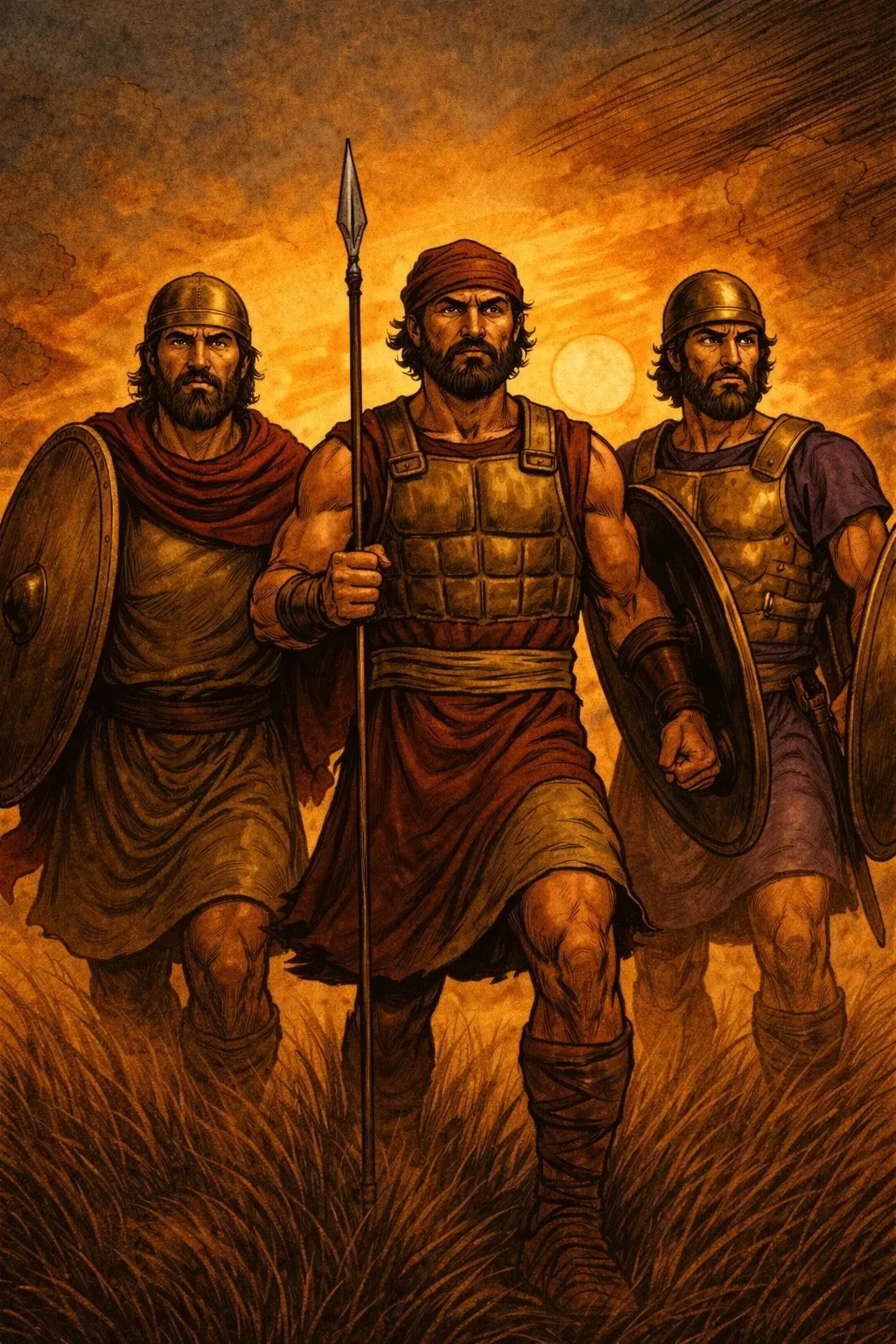
They were the hardest fighting men in Israel: thirty-seven warriors who stood with King David when the odds were impossible, and the LORD gave them victory. Here is who they were, what they did, and where to read it in Scripture.
From Outcasts to Mighty Men
The story starts with a man on the run. Anointed king but hunted by Saul, David escaped to the cave of Adullam. His brothers and his father's house came down to him, and then others came too:
And every one that was in distress, and every one that was in debt, and every one that was discontented, gathered themselves unto him; and he became a captain over them: and there were with him about four hundred men.— 1 Samuel 22:2 (KJV)
These were not polished soldiers. They were distressed men, men in debt, men persecuted and hunted right alongside David as Saul pursued him. David led them, and over years of hard campaigning they became a band of fighting men whose loyalty became famous. 1 Chronicles 12:8 describes some who joined him as men "whose faces were like the faces of lions, and were as swift as the roes upon the mountains." When Amasai came to David, he said, "Thine are we, David, and on thy side… for thy God helpeth thee" (1 Chronicles 12:18).
The Three
At the top stood three men whose deeds put them in a class of their own (2 Samuel 23:8–12; 1 Chronicles 11:11–14):
- Josheb-basshebeth the Tahchemonite, also called Adino the Eznite and Jashobeam. Chief of the Three, he wielded his spear against 800 men killed at one time (2 Samuel 23:8).
- Eleazar son of Dodo. When the men of Israel withdrew, he struck down the Philistines until his hand was weary and clung to the sword (2 Samuel 23:9–10).
- Shammah son of Agee. When the men fled, he took his stand in a field of lentils, defended it, and the LORD worked a great victory (2 Samuel 23:11–12).
Water from the Well of Bethlehem
At harvest time, with a Philistine garrison in Bethlehem, David said he longed for a drink from the well by the gate of his hometown. Three of the thirty chief men broke through the Philistine camp, drew the water and brought it back. David would not drink it. He poured it out to the LORD, because it had been carried at the risk of their lives. Read the full account (2 Samuel 23:13–17).
Abishai and Benaiah
Abishai, brother of Joab, was chief of the Thirty and wielded his spear against 300 men (2 Samuel 23:18–19). Benaiah son of Jehoiada struck down two of Moab's mightiest men, killed a lion in a pit on a snowy day, and took a spear from a huge Egyptian and killed him with it (2 Samuel 23:20–23). Both "won a name beside the three," but did not attain to the Three.
The Thirty
Below them stood the Thirty, a roll of honor listed by name and hometown. It opens with Asahel, brother of Joab, and closes with Uriah the Hittite. The text then gives the total: "thirty and seven in all" (2 Samuel 23:39).
| Name (2 Samuel 23) | Verse |
|---|---|
| Asahel brother of Joab; Elhanan son of Dodo of Bethlehem | 24 |
| Shammah of Harod; Elika of Harod | 25 |
| Helez the Paltite; Ira son of Ikkesh of Tekoa | 26 |
| Abiezer of Anathoth; Mebunnai the Hushathite | 27 |
| Zalmon the Ahohite; Maharai of Netophah | 28 |
| Heleb (Heled) son of Baanah of Netophah; Ittai son of Ribai of Gibeah | 29 |
| Benaiah of Pirathon; Hiddai of the brooks of Gaash | 30 |
| Abi-albon the Arbathite; Azmaveth of Bahurim | 31 |
| Eliahba the Shaalbonite; the sons of Jashen; Jonathan | 32 |
| Shammah the Hararite; Ahiam son of Sharar the Hararite | 33 |
| Eliphelet son of Ahasbai of Maacah; Eliam son of Ahithophel the Gilonite | 34 |
| Hezro of Carmel; Paarai the Arbite | 35 |
| Igal son of Nathan of Zobah; Bani the Gadite | 36 |
| Zelek the Ammonite; Naharai of Beeroth, armor-bearer of Joab | 37 |
| Ira the Ithrite; Gareb the Ithrite | 38 |
| Uriah the Hittite | 39 |
1 Chronicles 11:26–47 repeats the roll with some spelling differences and adds more names, such as Zabad son of Ahlai and Adina the Reubenite. Notice who is on the list: an Ammonite, a Hittite, a man from Zobah. Men from many places stood under one king.
Why Their Story Still Matters
Scripture keeps saying the same thing about these men's victories: "the LORD wrought a great victory" (2 Samuel 23:10, 12). They were brave, but their strength came from God. They were loyal to their king, they held ground when others ran, and they risked everything for the man God had chosen. That is the kind of faithfulness, courage and godly character worth handing down from fathers to sons and from parents to children.
Meet the Mighty Men
41 bold coloring pages of King David's warriors, straight from 2 Samuel 23 and 1 Chronicles 11. Ages 5–99+. Paperback, $9.99.
Get the Coloring BookQuestions About David's Mighty Men
Who were David's mighty men?
David's mighty men (Hebrew gibborim) were the elite warriors who fought for David, first while he was on the run from King Saul and later when he reigned as king of Israel. Their names and deeds are recorded in 2 Samuel 23:8–39 and 1 Chronicles 11:10–47.
How many mighty men did David have?
2 Samuel 23:39 says there were thirty-seven in all. The list is built from the Three (Josheb-basshebeth, Eleazar and Shammah), two commanders who won a name beside the Three (Abishai and Benaiah), and the Thirty. 1 Chronicles 11 gives a longer list that adds more names.
Who were David's three mighty men?
The Three were Josheb-basshebeth the Tahchemonite (called Adino the Eznite in the KJV), chief of the Three; Eleazar son of Dodo the Ahohite; and Shammah son of Agee the Hararite (2 Samuel 23:8–12).
Where is the story of David's mighty men in the Bible?
The main passages are 2 Samuel 23:8–39 and 1 Chronicles 11:10–47, with more warriors who joined David in 1 Chronicles 12. Their beginning is in 1 Samuel 22:1–2, at the cave of Adullam.
Who killed a lion in a pit on a snowy day?
Benaiah son of Jehoiada. 2 Samuel 23:20 and 1 Chronicles 11:22 say he went down and struck down a lion in a pit on a day when snow had fallen. David later set him over his bodyguard, and under Solomon he became commander of the whole army (1 Kings 2:35).
Who brought David water from the well of Bethlehem?
Three of the thirty chief men broke through the Philistine camp, drew water from the well by the gate of Bethlehem, and carried it back to David. David refused to drink it and poured it out to the LORD, because they had risked their lives (2 Samuel 23:13–17; 1 Chronicles 11:15–19).
Was Uriah the Hittite one of David's mighty men?
Yes. Uriah the Hittite is the last name in the list of the mighty men in 2 Samuel 23:39 and appears in 1 Chronicles 11:41. He was the loyal soldier whose wife was Bathsheba (2 Samuel 11).
Where did David's mighty men come from?
Many began as outcasts. 1 Samuel 22:2 says those in distress and in debt gathered to David at the cave of Adullam, men persecuted along with him as Saul hunted David, about four hundred men, and he became their captain. Under David and before God, those men became mighty warriors.
Is there a David's Mighty Men coloring book?
Yes. David's Mighty Men Coloring Book has 41 bold coloring pages of King David's warriors, drawn from 2 Samuel 23 and 1 Chronicles 11, for ages 5–99+. It is a $9.99 paperback on Amazon.